


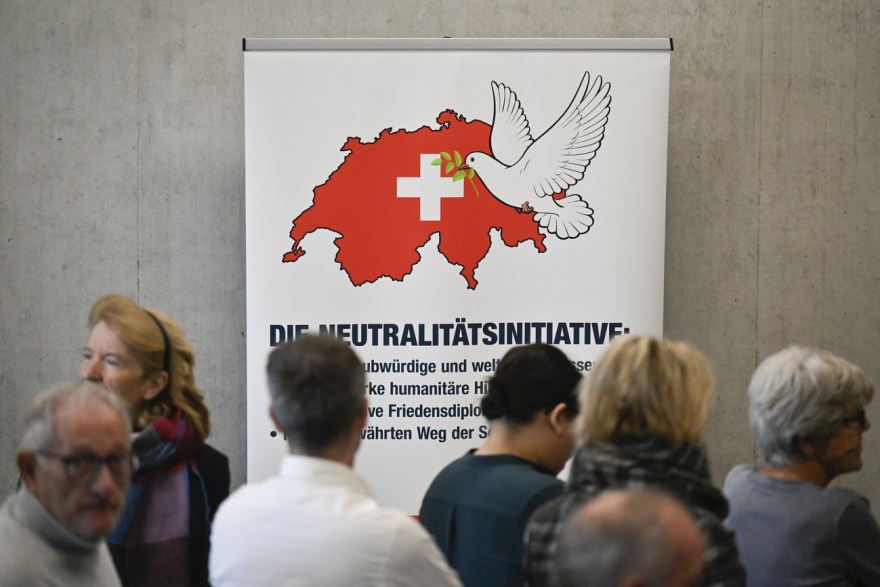
For generations, Switzerland derived an extraordinary place in international affairs from choosing not to belong to any side. When relations broke down elsewhere, doors remained open here. Governments that distrusted one another accepted Swiss good offices, adversaries met on Swiss ground, international institutions made Geneva their home, and humanitarian action could cross divisions that politics could not. Switzerland became useful because it was trusted, and trusted because its independence was expected to survive the quarrels of others.
That expectation served Switzerland exceptionally well. It brought influence without great power, international importance without political alignment, and prosperity reinforced by a national reputation for discretion, stability and reliability. It also served those who needed somewhere between opposing camps where communication, mediation and humanitarian action could remain possible. Trust required no written contract. It rested on something more demanding: the expectation that when others took sides, Switzerland could still be trusted to remain Switzerland.
That condition carried a price. Independence matters least when everybody agrees and most when pressure demands allegiance. The value of Swiss neutrality therefore never lay simply in declaring it, but in sustaining the confidence of others when doing so became difficult. That is the confidence Switzerland has begun to betray.
The consequences reach far beyond governments. Journalists, dissidents, activists and persecuted minorities rely upon institutions capable of operating across political divisions. Prisoners and families separated by conflict depend upon intermediaries able to cross them. Humanitarian organizations require access to opposing sides, while smaller states need diplomatic ground not politically owned by larger ones. Switzerland did not create this architecture, but became one of its principal custodians because its independence was considered sufficiently credible to use.
This is the distinction obscured in much of the Swiss debate on neutrality. Switzerland can define neutrality in law and declare its observance, but it cannot declare itself trusted. The Federal Council’s own neutrality report provides the decisive standard: whether other states recognize Swiss neutrality depends primarily upon the credibility of Swiss actions. Neutrality is declared by Switzerland. Its credibility is granted by others.
That distinction matters because the international order has fractured. Russia and the West are in open confrontation, American-Chinese rivalry has intensified, wars have exposed profound disagreements over the application of international law, and sanctions have become instruments of geopolitical power. The resulting divisions have reopened the question of who may credibly speak for a supposedly universal international order. This is precisely the environment in which Swiss independence should become more valuable.
Instead, Switzerland has reduced the visible distance between itself and its European geopolitical environment. Its extensive adoption of EU sanctions against Russia can be defended as compatible with the law of neutrality, as the Federal Council maintains. But legal compatibility answers only one question. The more consequential one is whether governments outside the Western political sphere continue to regard Switzerland as sufficiently independent to entrust it with functions they would hesitate to entrust to an aligned state. Legal status does not guarantee external credibility.
The same test applies when Swiss responses to grave conflicts differ substantially. Russia and Israel are neither legally nor factually identical, and different circumstances can plainly justify different measures. The issue is not identical treatment, but whether the principles explaining different treatment remain sufficiently coherent and consistently applied to preserve confidence in Swiss impartiality. That judgment cannot finally be made in Bern because the asset at stake is confidence abroad.
This is where the breach has already occurred. The discipline expected of neutrality is not proved by preserving its legal definition, but by maintaining sufficient independence and consistency when political pressure makes them costly. Switzerland inherited the benefits of that discipline and has allowed its application to become visibly entangled with the geopolitical environment from which its exceptional role required recognizable distance. The failure of stewardship has therefore already occurred; the full loss of trust has not. Reputations accumulated over generations survive for a time even after the conduct that created them begins to change.
The betrayal concerns not principally Moscow, Beijing, Washington or Brussels, but those who depended upon credible ground remaining between them. The journalist does not require Switzerland to approve his reporting, the dissident endorsement of her politics, the minority preference for its history, or the humanitarian organization a political verdict before treating victims. They require principles that survive the identity of those requiring them. That is the practical meaning of impartiality.
Switzerland accepted considerable benefits from the reputation supporting that role: diplomatic relevance, international institutions, commercial opportunity and influence disproportionate to its size. There was nothing improper about benefiting from trust; reliability deserves a premium. But stewardship means preserving the conditions upon which an inherited asset depends. Switzerland cannot claim the dividends of exceptional independence while treating the discipline sustaining them as negotiable when that discipline becomes costly.
The comparison with Switzerland’s wider reputation is instructive. A Swiss watch that keeps time only under favorable conditions is not reliable, just as money that remains safe only while circumstances are comfortable is not safely held. Neutrality deserves no lesser standard. Each rests upon the same proposition: Swiss means reliable when reliability matters.
This does not mean foreign policy determines whether somebody buys a Swiss watch, chooses a Swiss pharmaceutical product or deposits money in Zurich. The connection is reputational, not mechanical. Swiss authorities themselves recognize that Swiss origin commands economic value because qualities associated with Switzerland create confidence and a willingness to pay a premium. Damage to political reliability does not automatically damage Swiss products, but a country that monetizes its reputation has particular reason to protect the credibility attached to its name.
The consequences are unlikely to resemble catastrophe. Switzerland may remain wealthy, its companies excellent, its banks formidable and Geneva prosperous long after doubts about its political independence begin to grow. The evidence will emerge more quietly: negotiations conducted in Istanbul, Doha or Muscat; governments developing alternative channels; emerging powers building institutions in jurisdictions they consider better positioned between competing centers; and a diplomatic generation learning that Geneva is one venue among several. Switzerland need not be punished to lose ground. It need only become more replaceable.
That danger emerges precisely when Switzerland’s traditional function should be appreciating in value. A more multi-polar international order requires credible ground between competing powers more urgently, not less. Switzerland possesses an exceptional combination of security, diplomatic experience, legal competence, financial sophistication, infrastructure and international institutions. Much of that can be replicated. Generational trust cannot.
Switzerland is therefore placing the accumulated capital of that trust, and the position built upon it, at risk precisely as international demand for credible neutral ground should be increasing. The distinction between breach and consequence is essential: the failure of discipline belongs to the present; the depreciation of trust belongs to the future. The first results from choices made by Switzerland. The extent of the second will be determined by choices made elsewhere.
The danger is not that Switzerland suddenly becomes poor, but that it remains prosperous while becoming ordinary: Geneva still important but less indispensable, Swiss diplomacy still competent but less exceptional, Swiss institutions still respected but increasingly replaceable. Then the questions become practical. Why Geneva rather than Doha? Why Swiss mediation rather than another intermediary? Why Swiss custody rather than another stable jurisdiction? Why establish the next international institution in Switzerland rather than somewhere positioned more convincingly between emerging centers of power? Ultimately, why pay the Swiss premium?
September’s debate is therefore about considerably more than Russia, sanctions or constitutional doctrine. Switzerland itself acknowledges that neutrality can reinforce trust and its credibility as a mediator. The question it cannot answer for itself is whether that confidence survives abroad.
The present breach does not mean Switzerland’s inheritance has disappeared. It means Switzerland has begun spending what it did not create. Accumulated confidence may conceal the cost for years because trust decays more slowly than the conduct that sustains it. But if the discipline is not restored, others will adjust. Journalists will find other platforms, humanitarian organizations other intermediaries, governments other rooms, institutions other hosts and capital other jurisdictions. There will be no ceremony marking the loss because trust requires none to depart. The world will simply stop expecting Switzerland to be different, and the ultimate damage will not be that it concludes Swiss neutrality is unreliable, but that it begins to wonder whether Switzerland is.
Harri Ihring, Geneva 31 August, 2026