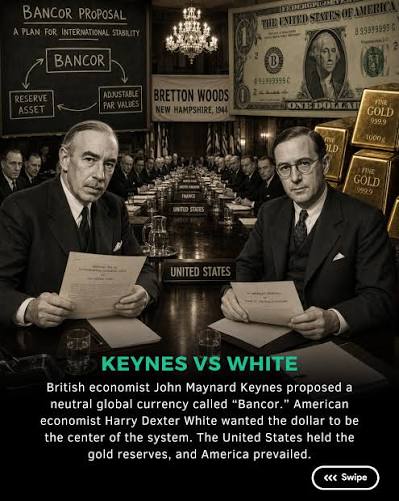
At Bretton Woods, John Meinard Keynes proposed an International Clearing Union using Bancor as a neutral international unit of account. National currencies would remain sovereign; international balances would be cleared multilaterally; persistent creditor and debtor positions would both carry an obligation to adjust.
A different architecture prevailed: currencies were linked to the dollar and the dollar to gold. After convertibility ended in 1971, the dollar remained the dominant international currency. The resulting tension is familiar: a national monetary system also performs functions required by the global economy. What later became known as the Triffin problem remains relevant precisely because national and international monetary interests cannot always coincide.
What has changed is the technical environment.
The SDR demonstrates that a basket-based international unit can exist without becoming a national currency. Agorá is demonstrating multi-currency settlement using tokenised central-bank reserves and commercial-bank deposits. Nexus is developing interoperability between national instant-payment systems. The G20 and FSB are pursuing the same broader objective: faster, cheaper and more accessible cross-border payments, while acknowledging that the benefits have not yet reached end users sufficiently.
The question is whether these developments eventually permit a return to the unresolved part of Keynes’s proposition.
A Global Clearing Unit (GCU) could provide a neutral unit of account and digital clearing layer between sovereign currencies. It would not replace the dollar, euro, renminbi or other currencies, nor require a new retail currency. Its purpose would be narrower: measure, transact and clear across monetary systems without making any one national currency the necessary intermediary.
The harder part is institutional, not technological: governance, convertibility, liquidity, settlement finality, allocation of risk, and rules for correcting persistent imbalances. Any credible GCU would have to solve these collectively and without transferring monetary sovereignty to a new centre.
A second question could then be considered independently. If the clearing system has an agreed economic revenue base, participating members could allocate a small, predetermined share as a Humanity Dividend to finance defined basic Human Responsibilities. The rule would be explicit; monetary governance and allocation of the dividend would remain institutionally separate.
There is no cost-free path. Transition carries monetary, political and operational risk. But fragmentation into competing currency and payment blocs carries its own costs: duplication, friction, geopolitical exposure and potentially disorderly adjustment.
The relevant comparison is therefore not change versus stability, but managed evolution versus unmanaged fragmentation.
If developed carefully and over time, the result could be a more circular, net-positive and human-first economy: sovereign monetary systems remain intact, global exchange becomes more neutral and efficient, and a defined fraction of the value generated by that exchange is returned to financing the common responsibilities on which the system itself depends.
Not a new monetary order imposed from above, but a possible completion of an architecture Keynes left unfinished.